Tuesday, January 31, 2006
The Power of Belief
Today I stumbled across an MDRC school reform evaluation that explores the relationship between student engagement and perceived academic competence on achievement in reading and mathematics. The findings suggest that engagement in school and students’ perception of their own academic competence influence achievement in mathematics.
So remember those cool teachers you had who acted like you might actually amount to something? Those are the folks who are key to student development. "The earlier schools and teachers begin to build students’ confidence in their ability to do well, the better off students will be. Teachers whom students see as supportive and who set clear expectations about behavior help create an atmosphere in which students feel in control and confident about their ability to succeed in future educational endeavors." Read more...


Tuesday, January 24, 2006
The Grit Factor
 Penn researcher, Angela Lee Duckworth tells us that intellectual superstars aren't successful just because they're smart -- it's because they've got "grit" or persistence. In a study of West Point freshman cadets, Duckworth found that grit predicted successful completion of their summer training program. Grit beat out high school class rank, SAT scores, athletic achievement, community leadership experience and faculty appraisals.
Can we teach grit or is success limited to obsessive compulsives? Duckworth and other researchers suggest that it's time to teach persistence and help kids understand how to overcome obstacles. Another strong suggestion is to the parents. "The most important thing parents can do to help kids succeed is to guide them in finding whatever it is they can love over the long haul." Read more...
Penn researcher, Angela Lee Duckworth tells us that intellectual superstars aren't successful just because they're smart -- it's because they've got "grit" or persistence. In a study of West Point freshman cadets, Duckworth found that grit predicted successful completion of their summer training program. Grit beat out high school class rank, SAT scores, athletic achievement, community leadership experience and faculty appraisals.
Can we teach grit or is success limited to obsessive compulsives? Duckworth and other researchers suggest that it's time to teach persistence and help kids understand how to overcome obstacles. Another strong suggestion is to the parents. "The most important thing parents can do to help kids succeed is to guide them in finding whatever it is they can love over the long haul." Read more...
Monday, January 23, 2006
Sunday TV: People Do Matter
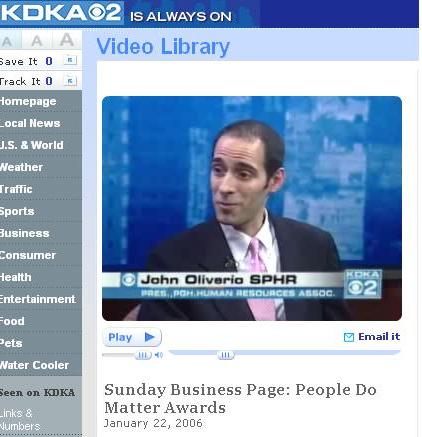 This Sunday, Jon Delano aired a segment about the "People Do Matter" initiative. People Do Matter recognizes companies for outstanding accomplishments in human resources, training and organizational development.
View the video clip here...
Learn more about PDM (nominate an organization!) here...
This Sunday, Jon Delano aired a segment about the "People Do Matter" initiative. People Do Matter recognizes companies for outstanding accomplishments in human resources, training and organizational development.
View the video clip here...
Learn more about PDM (nominate an organization!) here...
Tough School-to-Work Question
"How can you have a successful school-to-work program if there's not enough room in the curriculum for kids to earn any real technical certification?" Jay Matthews poses this and other tough questions for Chris Peters, who coordinates Advancement via Individual Determination, at Cajon High School in San Bernadino, Calif. Read more here...
Friday, January 20, 2006
About the Region
Usually I try to post information about career education and workforce development but I just have to say a few words about my favorite blog -- http://pittsblog.blogspot.com/. While I don't always agree with his conclusions, Mike Madison does a great job exploring issues of regional concern. It's refreshing to see someone challenge popular points of view without just being a nay-sayer. Check it out...
College Illiteracy
It's no secret that most Americans believe that obtaining a college degree is a key to success. Here at HCPI we often shock people by reporting on how few students graduate in 6 years (about 50%). Now there's more upsetting news -- many students at college lack complex literacy skills. The study reports that more than half of students at four-year schools and more than 3/4 of students at two year schools "lack the skills to perform complex literacy tasks." This means that our college kids can't comprehend a newspaper editorial or compare credit card offers. Read more online...
Monday, January 09, 2006
Jobs You Can't Do Without
This article from workforce.com discusses the value of identifying positions that directly produce revenue, reach customers or encompass skills. The identification of these positions can help a company differentiate itself from rivals and better allocate resources. Here in SWPA, some forward-thinking organizations are already working hard to identify pivotal talent.
Friday, December 23, 2005
Happy Holidays!
 Found this pic in a BBC photo caption contest. The caption - "26 December, Job Centre"
Monday, November 28, 2005
Workforce Development & Healthcare
 On November 14th, the Institute of Politics convened a group to discuss the workforce development challenges facing the healthcare industry. The speakers made many interesting points. Many speakers emphasized the fact that workforce availability and quality impacts quality of care. There were also numerous remarks about the the skill shortages that exist across a broad range of occupations. (Workfore shortages go far beyond just nursing.) Many speakers also commented on the need for early and continuous career education. Finally, the need for collaboration across divergent groups is essential. No singular institution is going to fix the problem.
Of course, being a researcher -- I walked away from the event with more questions. Any answers out there?
On November 14th, the Institute of Politics convened a group to discuss the workforce development challenges facing the healthcare industry. The speakers made many interesting points. Many speakers emphasized the fact that workforce availability and quality impacts quality of care. There were also numerous remarks about the the skill shortages that exist across a broad range of occupations. (Workfore shortages go far beyond just nursing.) Many speakers also commented on the need for early and continuous career education. Finally, the need for collaboration across divergent groups is essential. No singular institution is going to fix the problem.
Of course, being a researcher -- I walked away from the event with more questions. Any answers out there?
- Nancy Zionts’ remarks emphasized the connection between workforce development and quality of care. If quality of care is the ultimate goal – which workforce development strategies are the most effective?
- Most of the panelists focused on building the pipeline of future workers. However, the PA Workforce Investment Board and numerous national groups have identified constraints in the educational pipeline such as a lack of faculty and clinical sites. How can the region overcome these pipeline problems?
- Jill Clements remarks briefly mentioned the impact of regulation on the healthcare industry. Credentialing, regulation and reimbursement policies have a major impact on the sector and the workforce. What do legislators need to know about how these regulations impact workforce quality and availability?
- Kathy Malloy and Jay Cannon mentioned the challenges of keeping pace with the rapidly changing educational requirements of the healthcare industry. One innovation that is reshaping the industry is the movement towards electronic health records. How does this innovation increase skill requirements for the workforce? Are our educational institutions prepared to meet this challenge?
- Steve Herzenberg discussed the need for a collaborative approach to workforce development. Are the region’s healthcare providers working collaboratively towards addressing workforce challenges or is it still a “go-it-alone” strategy?
Wednesday, November 23, 2005
Manufacturers Bemoan "Dearth of Career Counseling"
Yet another report (this one by NAM, the Manufacturing Institute and Deloitte Consulting) reports that a strong majority (83 percent) of manufacturers are struggling to serve customers because there are not enough qualified workers. Read more here.
Part of the problem is the image of manufacturing but skills are also in short supply. The NAM survey cited "significant dissatisfaction among manufacturers with the quality of kindergarten-to-grade 12 education and the dearth of adequate career counseling." A NAM representative summarized the challenge, "We must update the image of modern manufacturing in the minds of young people, their parents and educators, and encourage more students to study math and science or follow a technical career path."
One local group trying to make a difference in this area is the Advanced Manufacturing Careers Collaborative. There are many wonderful resources available on their website. Check it out.
Subscribe to:
Posts (Atom)

