Wednesday, March 29, 2006
Gaming ROI
Skill development via video game. Interesting.
http://www.wired.com/wired/archive/14.04/learn.html


Monday, March 27, 2006
Too Many Skilled Workers?
There's a new book on my reading list, "The Disposable American: Layoffs and Their Consequences" by Louis Uchitelle. The NYTimes had a thought provoking article about the topic in yestersday's paper. The sad story is that despite our best efforts to retrain laid off workers, sometimes it's nearly impossible to find new careers with comparable benefits and wages.
While there are many good points in the article, there were a few points that seemed oversimplified and misleading.
1. The author suggests that US employment policy is overly education and training-focused. This may have been the case under JTPA, but under WIA standards there is a much stronger effort to place people in jobs. We don't simply train people for positions because they want to go to training. There's a much stronger effort to train people for in-demand jobs.
2. "We have an oversupply of skilled people." This is a gross oversimplification of the labor market. People aren't widgets. Their skills take a while to be developed and refined. The real story is that we do a bad job predicting the skills and training that our economy needs. Look at the healthcare occupations that are begging for workers. Moreover, we have significant geographical challenges. Consider the issue of preparing enough educators. Pennsylvania has more than enough, yet other states do a lousy job preparing and finding educators.
3. "Rather than having a shortage of skills, millions of American workers have more skills than their jobs require. That is particularly true of college-educated people, who make up 30 percent of the population today, up from 10 percent in the 1960's. They often find themselves working in sales or as office administrators, or taking jobs in hotels and restaurants, or becoming carpenters, flight attendants and word processors." Yes, the author is correct that college is no guarantee of employment success. However, it's important to remember that usually our first or second job after college is a stepping stone. The labor market is fluid.
And by the way, what's wrong with a college grad working in sales?
I'd better not continue, there's smoke coming out of my ears. Other comments/thoughts about the article are welcome.
Friday, March 24, 2006
Women in Higher Ed.: Too Many or Not Enough?
Today I came across two interesting articles about women and higher education. The first story was published in the NYTimes. An admissions officer shares her frustration with the unintended consequences of women's liberation -- women’s increased interest (and achievement) is creating a much higher university standard for women than for men. Apparently campuses are concerned with preserving “gender equity.” As a result, many well qualified girls are being placed on the waitlist while boys with comparable grades and achievement are accepted.
Just minutes after I read this article, I stumbled across an article in the National Journal about the need to increase women's pursuit of math and science degrees. In fact, Bush Administration officials are considering how they might extend Title IX law (aimed at college athletic programs) to improve gender equity in research university science departments. Although women’s pursuit of science degrees has increased, men still lead in computer science and engineering by 3-to-1 and 4-to-1, respectively.
Tuesday, March 21, 2006
Career Exploration -- Not Just for Kids
Kids aren't the only ones looking for career guidance. As baby boomers hit retirement ages, many are opting to stay in the workforce. For those seeking a retirement job, AARP has a few suggestions: http://www.aarp.org/bulletin/yourlife/0905_sidebar_2.html
Monday, March 13, 2006
Fun and Games
 I came across this list of old fashioned job titles and thought they were worth sharing. (I like to use this as a trivia game when presenting to student audiences.)
Do you know what these people did for a living?
Town husband, tinkerer, ratoner, streaker, skinker, loblolly boy, honeydipper, hello girl, bookman?
A town husband was employed by the parish to collect money from fathers of illegitimate children for their upkeep. A tinkerer was a traveling repairman. A streaker prepared bodies for burial. A skinker was a tapster in an ale house. A ratoner was a rat catcher. A loblolly boy was a ship's doctor's assistant or errand boy. A honey dipper extracted raw sewage from out-houses. A hello girl was a telephone employee in the early 1900s. Finally, a bookman was a student.
Doesn't this make you love your job?
I came across this list of old fashioned job titles and thought they were worth sharing. (I like to use this as a trivia game when presenting to student audiences.)
Do you know what these people did for a living?
Town husband, tinkerer, ratoner, streaker, skinker, loblolly boy, honeydipper, hello girl, bookman?
A town husband was employed by the parish to collect money from fathers of illegitimate children for their upkeep. A tinkerer was a traveling repairman. A streaker prepared bodies for burial. A skinker was a tapster in an ale house. A ratoner was a rat catcher. A loblolly boy was a ship's doctor's assistant or errand boy. A honey dipper extracted raw sewage from out-houses. A hello girl was a telephone employee in the early 1900s. Finally, a bookman was a student.
Doesn't this make you love your job?
Monday, February 27, 2006
Work Hard, Earn Less
If you ever doubted the brutality of the labor market, take a look at articles in yesterday’s New York Times or today’s Christian Science Monitor.
Today's Christian Science Monitor also looks at the struggle of younger workers. On many measures, younger workers are falling behind. Median incomes are falling for younger households, education costs are rising dramatically -- leaving younger workers with high student loan and credit card debts, and rising healthcare costs are being shifted to the new workforce.
This is why we need HCPI speakers to get into the community and provoke thought and action with regard to career education and workforce development. Talking about what's wrong with the labor market only gets you so far. We've got to give people the tools to succeed.
Finally, I should mention that I wanted to also recommend an article by Paul Krugman about rising economic inequality. Ironically, though, you can only view the article online if you pay for/subscribe to NYTimes Select. Once again, the poor get imperfect market information.
Tuesday, February 21, 2006
HCPI Reception
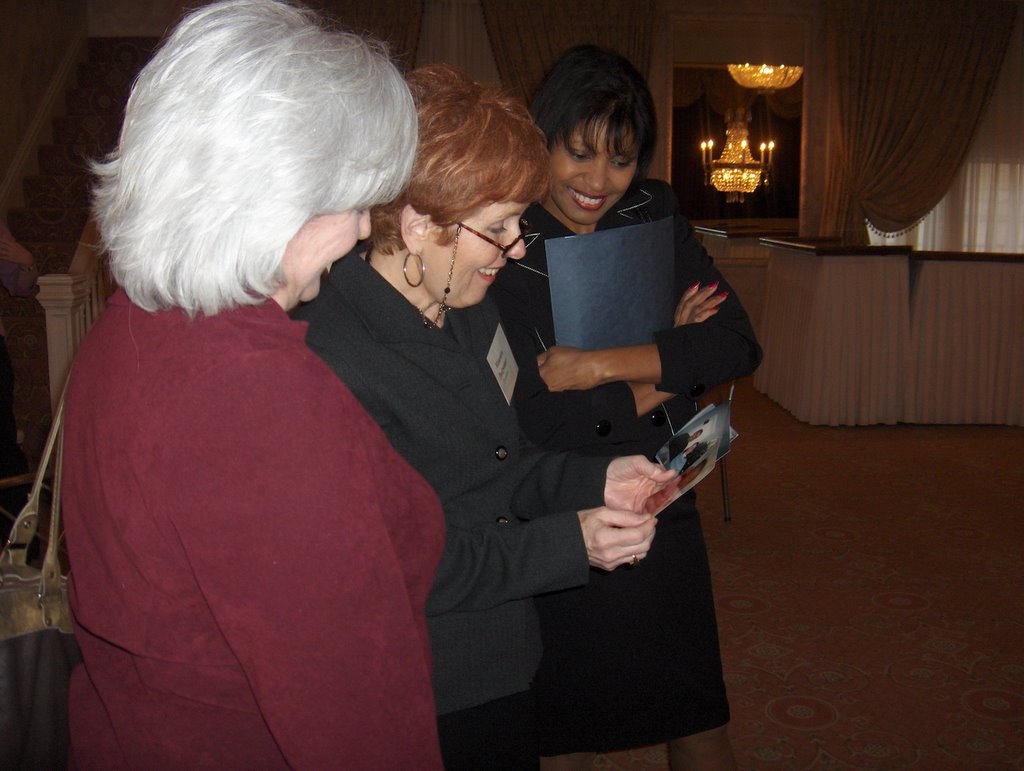 It was great to see so many HCPI speakers at our reception on February 16th. Your energy and enthusiasm continues to inspire me!
Secrets of College Success
The Washington Post recently explored the secrets of college graduation success. For once, there's good news -- a recent study by the US Department of Labor shows that more students are obtaining their college degree (66% of the students tracked completed their degree -- up from 60% in the previous study.) The study also reported that students taking more intensive classes are more likely to graduate. (Was that really a surprise?) There are lots of good tidbits for those of you interested in learning more about college persistence, achievement and outcomes.
I like the recommendations at the end of the Post article. (I've paraphrased.)
1. Just because you say you will continue your education after high school and earn a college credential doesn't make it happen. Wishing doesn't do it; preparation does.
2. Take the challenging course work in high school, and don't let anyone scare you away from it. If you cannot find the challenge in the school's offerings, find it online.
3. Read like crazy! Expand your language space! Don't waste precious credit hours on remedial courses in higher education.
4. The world has gone quantitative. A full range of disciplines and job tasks tells you why math requirements are not just some abstract school exercise.
5. Log on to college and community college Web sites pay attention to what to what they show you -- the assignments and examination questions given in major gateway courses you will probably take. If you do not see these indications of what to expect, push!
6. See if your nearest community college has a dual-enrollment agreement with your school system, allowing you to take significant general education or introductory occupational courses for credit while you are still in high school.
7. You are ultimately responsible for success in education. You are the principal actor. The power is yours. Seize the day -- or lose it!"
Tuesday, February 07, 2006
Are We Measuring What Matters?
 Do traditional economic measures work in a knowledge economy? This Business Week article argues that they do not. In fact, many knowledge building investments are simply not measured. For example, in the olden days companies spent a lot of money to train people. (You had to fly people to a training facility, hire instructors, pay overhead, etc.) Now you can take classes online. "At IBM, the training budget fell by $10 million from 2003 to 2004, a 1.4% decline, while the number of classroom and e-learning hours rose by 29%." As it stands, traditional economic measures fail to capture these types of productivity improvements.
Another interesting calculation -- the ROI of immigration. If immigrants come to the US already educated, they are adding to the economic value of the nation. "Most of the workers who immigrate to the U.S. each year have at least a high school diploma, while about a third have a college education or better. Since it costs, on average, roughly $100,000 to provide 12 years of elementary and secondary education, and another $100,000 to pay for a college degree, immigrants are providing a subsidy of at least $50 billion annually to the U.S. economy in free human capital. Alternatively, valuing their contribution to the economy by the total wages they expect to earn during their lifetime would put the value of the human capital of new immigrants closer to $200 billion per year." Read more...
Do traditional economic measures work in a knowledge economy? This Business Week article argues that they do not. In fact, many knowledge building investments are simply not measured. For example, in the olden days companies spent a lot of money to train people. (You had to fly people to a training facility, hire instructors, pay overhead, etc.) Now you can take classes online. "At IBM, the training budget fell by $10 million from 2003 to 2004, a 1.4% decline, while the number of classroom and e-learning hours rose by 29%." As it stands, traditional economic measures fail to capture these types of productivity improvements.
Another interesting calculation -- the ROI of immigration. If immigrants come to the US already educated, they are adding to the economic value of the nation. "Most of the workers who immigrate to the U.S. each year have at least a high school diploma, while about a third have a college education or better. Since it costs, on average, roughly $100,000 to provide 12 years of elementary and secondary education, and another $100,000 to pay for a college degree, immigrants are providing a subsidy of at least $50 billion annually to the U.S. economy in free human capital. Alternatively, valuing their contribution to the economy by the total wages they expect to earn during their lifetime would put the value of the human capital of new immigrants closer to $200 billion per year." Read more...
Friday, February 03, 2006
Engineering Dream Jobs
This special issue of IEEE Spectrum tells you all about the coolest engineering jobs. I have to say -- they're way cool. Martin Cooper uses lasers to restore priceless works of art. Grant Imahara builds that weird stuff you see on the Discovery Channel show -- MythBusters. And this guy tracks wild animals. The core message -- do something you love, be tenacious and flexible. And look out for the rhinos.
Subscribe to:
Posts (Atom)

